

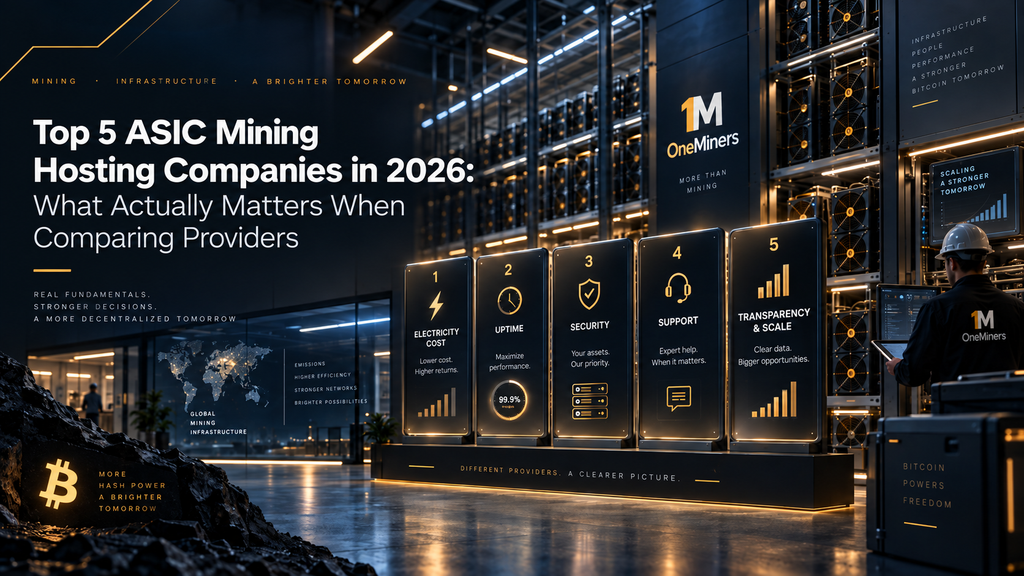
Search “best crypto mining hosting” and you’ll find a lot of listicles with confident-sounding scores — 98 out of 100, “brutally honest,” ranked by criteria nobody can verify. As a tech publication, we’d rather look at what’s actually checkable: published electricity rates, contract terms, facility locations, and uptime commitments you can hold a provider to. Here’s a grounded comparison of five hosting companies operating in 2026.
The four things worth actually checking
- Electricity rate and whether it’s fixed — this is 90%+ of your ongoing cost, so a floating rate is a floating risk.
- Facility diversification — one data center is one point of failure (regulatory, weather, grid).
- Uptime SLA and what you get if they miss it.
- Exit terms — can you pull your hardware out, and what does that cost?
1. OneMiners
OneMiners publishes fixed electricity pricing from 4¢/kWh and operates across more than a dozen sites — including the US (Georgia, South Carolina, Texas, Kansas), Nigeria, Ethiopia, Dubai, Finland, and Norway — which checks the diversification box better than most single-site hosts. They advertise 98%+ uptime and back hardware with a 7-year warranty, and publish a miner profitability table that’s a genuinely useful reference regardless of which host you pick. Worth noting for a tech audience specifically: they run an AI-based load and dispatch optimization layer on top of standard hosting, detailed in their mining news and technical updates.
2. Blockware Solutions
Combines a hardware dealer arm with hosting, which reduces coordination overhead if you’re buying and hosting at the same time rather than shopping separately.
3. Simple Mining
Iowa-based, majority-renewable grid, with precision billing that only charges for actual hash time — a rare feature that most hosts don’t offer.
4. EZ Blockchain
US-based, mobile and containerized data center design, built specifically for a bring-your-own-hardware customer rather than a buy-and-host bundle.
5. Compass Mining
A marketplace-style model with a comparatively low barrier to entry for a single machine, though contract terms are worth reading carefully — marketplace models can vary a lot between individual facility partners.
The consolidation nobody’s talking about
Two notable exits reshaped this market in 2025: River discontinued its Bitcoin mining product entirely, and Crusoe Energy sold its mining business to focus on AI datacenters. That’s worth knowing before you sign a multi-year contract with anyone — this is a market where “who’s still standing in three years” is a real question, not a hypothetical one.
Bottom line
Pull the current published rate sheet from your top two or three candidates, run your specific hardware through each provider’s numbers, and confirm the electricity contract length before committing. A host’s own explainer on how hosting works is a decent starting checklist even if you end up choosing someone else.