

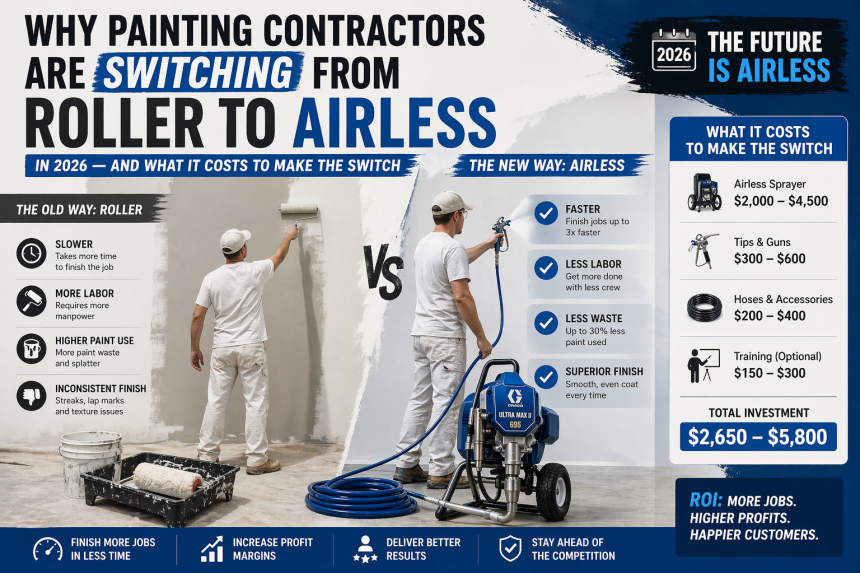
If you’ve been in the painting business for more than five years, you remember when airless sprayers were something you pulled out only for new construction or commercial work. Residential repaint jobs? You rolled. It was faster to set up, easier to clean, and there was no masking nightmare to deal with.
That calculation has shifted dramatically. In 2026, more residential and commercial painting contractors are running airless sprayers as their primary application method — not just on big jobs, but on standard repaint work that would have been rolled five years ago. Labor costs, client expectations for finish quality, and significant improvements in sprayer technology have all moved in the same direction at once.
This article breaks down exactly why the switch is happening, what the real numbers look like, and what it actually costs a contractor to make the transition — including equipment, training time, and the ongoing maintenance that keeps an airless rig running at full productivity.
The Core Problem Roller Contractors Are Running Into
The economics of residential painting have changed more in the last three years than in the previous fifteen. Labor is the biggest factor. When painters were paying helpers $15–$18 an hour, rolling was fine. You could put two painters on a job and get through a standard 2,000 square foot interior in two days without anyone breaking a sweat.
At $22–$28 per hour — which is where skilled labor sits in most major markets in 2026 — the calculation doesn’t work the same way. Every extra day on a job is money that comes directly out of margin. And residential repaint jobs are getting larger, not smaller. Homeowners who spent the pandemic years inside their houses have developed opinions about finish quality that a standard roller job doesn’t always satisfy.
The second factor is throughput. A painter rolling walls can comfortably cover 150–200 square feet per hour on a good day, accounting for cut-in time and reloading. An experienced painter running an airless sprayer with a properly sized tip can cover that same area in a fraction of the time. Industry data consistently shows airless sprayers covering surfaces 2 to 4 times faster than roller application on open surfaces. That’s not a marginal improvement. On a 3,000 square foot exterior repaint, the difference between rolling and spraying can be an entire day of labor — $300–$500 in wages before you’ve even factored in the additional jobs that crew could complete in that time.
What the Real Productivity Numbers Look Like
The productivity gap between rolling and spraying is real, but contractors who have been through the transition are honest about something the marketing materials don’t say: the time savings come from application, not from setup and cleanup.
Here’s what a realistic day looks like for each method on a standard 2,500 sq ft exterior repaint:
Rolling a 2,500 sq ft exterior:
- Prep and masking: 1.5 hours
- Application (two coats): 6–7 hours
- Cleanup: 30 minutes
- Total: approximately 8–9 hours
Spraying a 2,500 sq ft exterior:
- Prep and masking (more thorough): 2.5–3 hours
- Application (two coats): 2–3 hours
- Flush and cleanup: 45 minutes
- Total: approximately 5.5–7 hours
The time saving is real — roughly 2–3 hours on a job this size — but contractors who expect to cut their job time in half are setting themselves up for frustration. The masking is more extensive with a sprayer, especially around windows, trim, landscaping, and neighboring surfaces. The cleanup, even on a well-maintained machine, takes longer than washing out a roller sleeve. Where spraying wins decisively is on the application phase itself, and on finish quality on large flat surfaces — siding, fascia boards, wide ceilings — where a roller leaves texture and a sprayer does not.
The math gets much more compelling on larger jobs. On a full commercial exterior or a new construction interior with bare drywall, the setup cost of masking is proportionally much smaller relative to the surface area being covered. This is why spraying is essentially universal in new construction and why the residential repaint market is catching up.
Why 2026 Is Different from 2020
Three things have changed that make airless sprayers more viable for everyday contractor work than they were five years ago.
Machine reliability has improved significantly. The Graco Ultra 395 PC — which has been Graco’s most popular contractor sprayer for years — now features the Endurance Chromex piston pump with V-Max Blue packings that last roughly twice as long as previous generations. SmartControl pressure technology eliminates the pressure fluctuation that used to cause uneven fan patterns when a painter changed direction or speed. The machines are more consistent in the hands of painters who aren’t airless specialists, which lowers the skill floor for producing a quality result.
Pump repair has become faster and cheaper. One of the biggest hesitations contractors had about airless sprayers was maintenance-related downtime. The ProConnect cartridge system — available on several Graco models — lets a painter swap out a pump in under five minutes with no tools. Even on models without ProConnect, packing kits are inexpensive and rebuilding a fluid section is a 30-minute job that any painter can learn. The era of sending a sprayer to a service center for a week every time the packings wore out is largely over for contractors who keep basic OEM parts on the van.
Labor costs have made the ROI conversation impossible to ignore. At current labor rates in most U.S. markets, a contractor who completes one additional job per week because they’ve switched from rolling to spraying on appropriate jobs recovers the cost of an entry-level contractor sprayer in approximately four to six weeks. That’s not a theoretical number. That’s the math that painting business owners across the country are doing in 2026 and arriving at the same conclusion.
What It Actually Costs to Make the Switch
This is where most articles on this topic get vague. Let’s be specific.
Equipment Cost
The entry point for a legitimate contractor-grade airless sprayer is the Graco 390 PC, which runs approximately $800–$1,000 new. This machine handles most residential work — walls, ceilings, exterior siding — with a standard tip in the 413–515 range. It’s capable, but painters who spray daily will outgrow it within a year.
The machine most full-time residential contractors end up on is the Graco Ultra 395 PC, which retails in the $1,500–$1,800 range. This is Graco’s most popular contractor sprayer for a reason — it handles a wide range of coatings, runs all day without issue, and the Endurance pump is built for production use. For contractors doing commercial or larger residential work, the Ultra Max II 490 or 495 — in the $2,000–$2,500 range — adds more power and supports larger tip sizes for elastomerics and primers.
For gas-powered production work — multi-unit complexes, commercial exteriors, large institutional jobs — the GMax series starts around $3,500 and goes up from there. Most contractors starting out don’t need to go here initially.
Starter equipment budget: $1,500–$2,500 for one solid electric rig with a backup tip set, a 50-foot hose, and a gun.
Accessories and Consumables
The sprayer is just the beginning. Here’s what a first-time airless contractor actually needs:
- Spray tips: Plan on three to five tips in different sizes. A 415 for latex and primers, a 515 for heavier coatings, a fine-finish tip for doors and trim. Graco RAC X tips run $15–$25 each and last 30–50 gallons depending on material abrasiveness. Budget $100–$150 for an initial tip set.
- 50-foot hose: Usually included with the sprayer. A second 50-foot extension for longer runs costs $80–$120.
- Masking supplies: This is often underbudgeted. For exterior spraying, you’ll need quality tape, poly sheeting, drop cloths rated for paint overspray, and window masking material. Budget $200–$300 for your initial supply.
- Pump Armor and throat seal liquid: Storage fluid to protect the pump between jobs. A gallon of Pump Armor runs about $20 and is one of the most important preventive maintenance items you can buy.
Total accessories budget for a new sprayer setup: $400–$600 on top of the machine.
The Learning Curve — and What It Actually Costs
This is the honest part that most equipment salespeople skip. Switching from roller to airless has a real learning curve, and that learning curve has a dollar value.
Most painters need 30–50 hours of actual spraying time before they’re consistently producing results that are as good or better than their rolled work. During that period, expect:
- More overspray than you planned for on your first few jobs
- At least one tip clog that takes 10 minutes to diagnose and clear
- One or two surfaces that need a second coat because the tip size or pressure was wrong
- One job where masking took 45 minutes longer than you budgeted
None of this is catastrophic. All of it is normal. The contractors who give up on airless spraying in the first month are almost always the ones who went in expecting immediate perfection. The ones who stick through the learning curve — typically 6–10 jobs — describe a fairly consistent turning point where it clicks and they stop thinking about the machine and just paint.
Budget conservatively for the learning curve: expect to leave about 15–20% more time per job for the first eight to ten airless jobs while you’re calibrating your masking speed, tip selection, and pressure settings.
Ongoing Maintenance Costs
An airless sprayer that is properly maintained costs very little to keep running. An airless sprayer that is neglected costs a great deal.
The main wear items on a Graco contractor sprayer are:
- Pump packings: Replace every 150–200 hours of use, or about every 600–800 gallons with proper daily flushing. A packing kit runs $30–$85 depending on the model. This is not optional — running worn packings damages the cylinder and turns a $50 repair into a $300 one.
- Spray tips: Replace when the orifice wears oval — you’ll see it in a widened, uneven fan pattern. For production painters, a tip might last 60–80 gallons. For part-time users, much longer.
- Inlet and outlet valve kits: These need replacement when the sprayer starts having trouble priming or holding pressure. Budget $30–$90 per kit, and expect to replace them every one to two years of production use.
- Filters and strainers: Cheap, often forgotten. A clogged manifold filter is the most common cause of mysterious tip clogs and uneven spray patterns. Keep a supply on the van. They cost $5–$15 each.
Annual maintenance budget for one production sprayer: $150–$300 in parts, plus 3–4 hours of your own time for rebuilds.
The Jobs Where Rolling Still Wins
A fair assessment has to include this: airless spraying is not always the right choice, even for contractors who own excellent equipment.
Rolling is still faster and more practical in these situations:
Occupied interiors with furniture in place. The masking required to protect a furnished room from overspray often takes longer than the time saved by spraying. Experienced contractors often roll occupied rooms and spray vacated ones.
Small accent walls and single-room touch-ups. If you’re repainting one bedroom wall or doing a quick color change on a bathroom, setting up and cleaning an airless rig doesn’t make economic sense. A roller is faster start to finish.
Very windy exterior conditions. Wind above about 10–12 mph makes overspray control difficult and paint atomization inconsistent. Professional contractors watch the weather and plan exterior spray days accordingly.
Cut-in work and trim. Even contractors who spray everything else typically brush and roll their trim and cut-in work. Fine finish spraying on trim requires a separate, lower-pressure setup, dedicated masking, and a steady hand. Most production painters find it faster to brush trim than to set up for fine-finish spraying.
The best contractors in 2026 don’t think in terms of “we spray” or “we roll” — they think in terms of which method produces the best margin on each specific job. Most high-volume residential contractors settle into a rhythm where they spray two to three days a week on appropriate jobs and roll on the others.
Making the Financial Case to Yourself (or Your Business Partner)
If you’re a painting contractor on the fence about the investment, here’s a simple framework.
Take your last ten residential repaint jobs. For each one, estimate how many hours of the job were in pure application — not prep, not cut-in, not cleanup, just applying paint to flat surfaces. Conservatively assume you could have applied that paint 2.5 times faster with an airless sprayer. Calculate the labor hours saved. Multiply by your crew’s hourly cost.
For most residential contractors doing volume work, that number lands somewhere between $3,000 and $8,000 per year in labor savings — and that’s a conservative estimate that doesn’t account for the additional jobs your crew could take on with that recovered time.
A mid-range contractor sprayer costs $1,500–$2,000. The math solves itself within one season.
The contractors who are hesitating in 2026 are mostly hesitating because of the maintenance question — “what happens when it breaks down on a job?” The answer to that question is preparation: keep a basic set of OEM parts on the van, learn how to do a pump rebuild, and know your supplier. A packing kit and an inlet valve kit in your toolbox means a breakdown is a 20-minute fix, not a ruined job day.
What to Buy First
If you’re ready to make the switch, here’s a practical starting point based on what working contractors actually recommend:
For residential repaint contractors: Start with the Graco Ultra 395 PC. It’s the right size for the work, the Endurance pump is proven, and parts are universally available. Don’t go smaller to save $400 — the 390 PC will hold you back within a year.
For contractors doing larger commercial or exterior work: The Ultra Max II 490 or 495 is the step up worth taking. More pressure, more tip flexibility, and the ability to run elastomerics and masonry coatings that the 395 struggles with under load.
For your first parts order, before the machine ever leaves the van: An extra pump packing kit, a set of inlet and outlet valve kits for your model, a supply of manifold filters, and a bottle of Pump Armor. These are not optional accessories — they’re what separate a contractor who can handle a breakdown on-site from one who loses a full day to a $30 part.
The Bottom Line
The shift from roller to airless among professional painting contractors in 2026 is not a trend driven by novelty or marketing. It’s driven by labor economics, improving machine reliability, and the competitive pressure of a market where clients increasingly expect spray-quality finishes on standard repaint work.
The total cost of making the switch — equipment, accessories, masking supplies, and a realistic allowance for the learning curve — lands between $2,500 and $4,000 for most contractors. That investment pays itself back within a single painting season for any contractor doing consistent volume work.
The contractors who are thriving in 2026 have made peace with the fact that airless spraying requires a different kind of discipline than rolling: more planning, more masking, more attention to machine maintenance. But the trade-off is a production speed and finish quality that rolling simply cannot match at scale.