

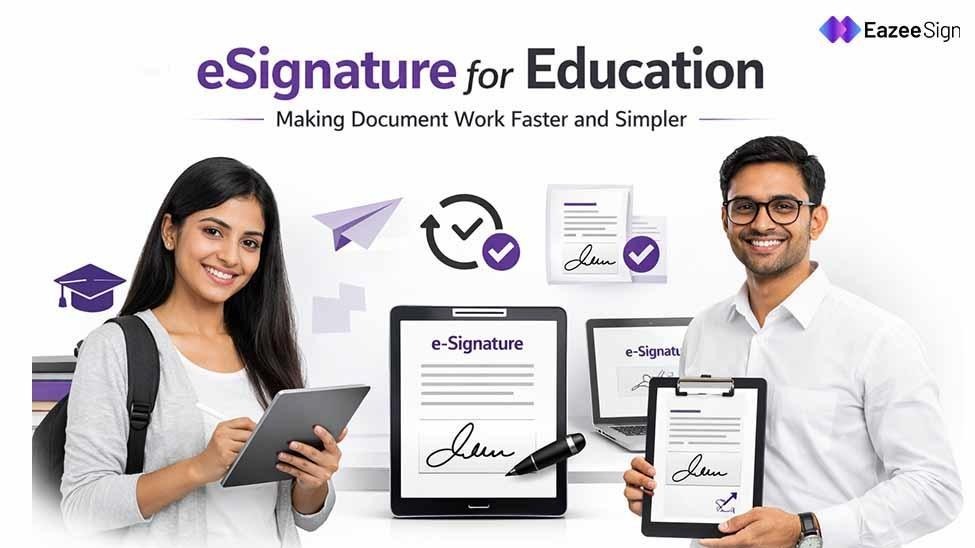
Paperwork is everywhere in education. The process continues without a break. Educational institutions handle documents throughout each day because their operations need documents from the admissions stage through to the internal approval stage.
Document processes at many locations show no development because teaching methods have progressed throughout time. Forms are printed. Signed. Scanned. Sent again. And the cycle repeats.
This is exactly where eSignature for education starts to change things. Not in a dramatic way, but quietly, by removing steps that don’t really need to exist anymore.
Why Document Handling Is Still Slow in Education
Most delays don’t come from teaching or operations. They come from paperwork.
Think about a simple admission form. A student fills it, prints it, signs it, then sends it back. The institution reviews it, signs internally, maybe shares it again. It sounds manageable, but when this happens across hundreds or thousands of students, it starts to slow everything down.
And it’s not just admissions.
- Student consent forms
- Faculty contracts
- Fee agreements
- Internal approvals
- Certificates and declarations
Each document moves through multiple hands. Sometimes physically, sometimes over email. Either way, time is lost in between.
Not because the work is complex. Just because the process is.
What eSignature for Education Actually Changes
The documents stay the same. The way they move changes.
Digital signing eliminates the requirement for printing and scanning documents multiple times. The system allows users to share documents which can then be signed and tracked through a single process without needing physical interactions.
So instead of going through:
Print → Sign → Scan → Send
It becomes:
Upload → Send → Sign → Done
Less effort. Fewer delays.
That shift may look small, but in education systems where volume is high, it makes a noticeable difference.
Where eSignatures Fit in Educational Institutions
It’s not limited to one department. It spreads across everything.
Admissions and Enrollment
This period represents the highest level of student activity throughout the academic year. Students submit forms, provide documents, sign declarations. All of this work needs to be done manually which creates backlogs that become worse during admission peak times. The eSignature for education system enables students to sign documents from remote locations which streamlines processing and eliminates unneeded hold times.
Student Consent and Agreements
Institutions require consent forms for their activities and their policies and their data usage requirements. The system allows users to send documents through electronic channels instead of requiring physical signature collection. Students or parents can review and sign from anywhere, without needing to visit the campus.
Faculty and Staff Documentation
Hiring and onboarding also involve multiple documents. Offer letters, agreements, policy acknowledgments… all of these require signatures. Digital signing speeds up onboarding and keeps everything organized.
Internal Approvals
Not all documents are external. Internal approvals, departmental requests, or administrative documents can also move faster when signatures are collected digitally instead of manually.
Managing Documents Without Losing Track
Paper-based systems often create confusion. Files get misplaced. Versions get mixed up. When documents are handled digitally, tracking becomes easier. You know who has signed, who hasn’t, and where the document is in the process.
Features like:
- Audit trails
- Role-based access
- Document tracking
- Automated reminders
help keep everything structured and visible. It doesn’t remove complexity entirely, but it reduces unnecessary friction.
Security and Legal Considerations
This is usually where questions come up. Is it safe? Is it valid?
Electronic signatures are designed with security layers like authentication and activity tracking. These ensure that documents remain secure and that actions can be verified when needed.
In India, electronic signatures are legally recognized under the Information Technology Act, 2000. This means institutions can use them for agreements and official documentation, provided proper authentication methods are followed.
For most educational use cases, this level of compliance is enough.
The Role of Digital Signature Online in Education
Different documents have different levels of importance. Certain documents need stronger verification requirements which apply to compliance-related documents and certification documents and government process documents. The need for digital signature online solutions emerges at this point
Institutions require consent forms for their activities and their policies and their data usage requirements. The system allows users to send documents through electronic channels instead of requiring physical signature collection. Students or parents can review and sign from anywhere, without needing to visit the campus.
Educational institutions often use them for:
- Official certificates
- Government submissions
- Accreditation documents
- Legal agreements
So while eSignatures handle everyday workflows, digital signatures add an extra layer when needed.
Practical Benefits of eSignature for Educational Institute
The impact becomes visible over time. Processes that used to take days can be completed in hours. Teams spend less time managing paperwork and more time focusing on core activities.
Some noticeable improvements include:
- Faster admissions and onboarding
- Reduced paper usage
- Better document tracking
- Less dependency on physical presence
- Improved coordination between departments
None of this is revolutionary on its own. But together, it improves how institutions function.
Challenges While Adopting eSignature in Education
Change is never instant. Even small changes take time. Some common challenges include:
Resistance to change – Teams used to paper-based processes may hesitate initially.
Lack of awareness – Not everyone understands how digital signing works or how simple it actually is.
Vendor or user adaptability – Students, parents, or external parties may take time to adjust.
Initial setup confusion – Choosing tools, setting workflows, defining roles… it can feel unclear at first.
But most of these challenges reduce once people start using the system. Familiarity builds quickly.
How to Implement eSignature for Education
It doesn’t need a complete overhaul. Start small.
Begin with one process, like admissions or consent forms. Use eSignatures there, observe how it works, and then expand to other areas.
Define signing roles clearly. Set up templates for repeated documents. Train teams with simple walkthroughs. Over time, the process becomes part of regular workflow.
No need to rush.
Conclusion
Education systems are evolving. Slowly, but clearly. Digital classrooms, online learning, remote access… all of this is already happening. Document handling is just another piece of that shift.
eSignature for education helps remove delays that don’t really add value. It makes document processes faster, simpler, and easier to manage.
And in environments where scale matters, even small improvements can make a real difference.