

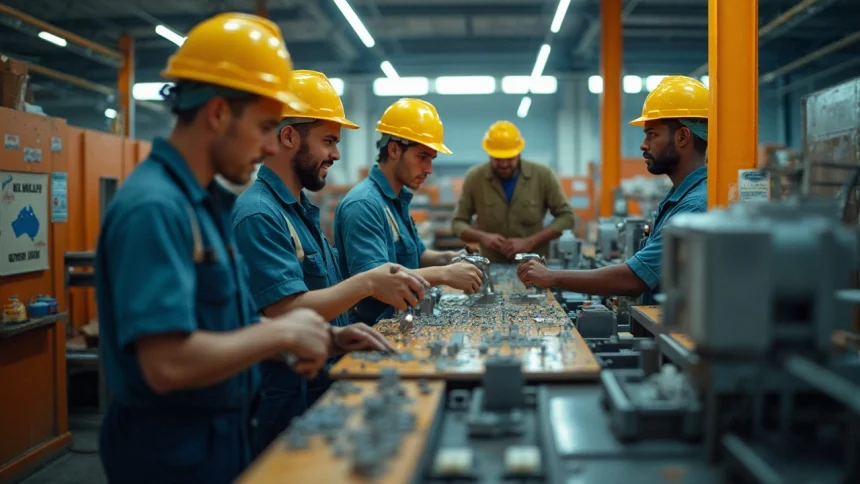
Seeing one’s own country’s label on products is indeed a matter of pride. However, in 2025, a simple label represents more than a specific nation; it also embodies the significance of the product’s premium quality, sustainability, and resilience to thrive in the market.
Especially in the Australian market, this dramatic shift in perception is driven by the ongoing global upheaval and diverse climate imperatives, wherein businesses and consumers are persistently questioning the actual costs of offshore production and delivery. So, what does this local advantage mean in a broader context?
Let’s find the answer to that through this publication, which uncovers why Australian businesses are increasingly supporting local manufacturers, whether from industrial components or artisan produce. Is it just a smart choice to align with consumer expectations or an initiative to build a secure and sustainable future?
Fortifying the supply chain
Despite being the most adopted supply chain model on a global scale, the just-in-time (JIT) strategy is fragile. Businesses have learned that low-cost offshore production creates high risks in various aspects. Here, local advantage emerges as a solution to curb these risks:
- Avoid global choke points: The International supply chain is often dependent on unpredictable factors, including pandemic lockdowns, geopolitical tensions, and regional conflicts. For example, a day’s delay at a congested foreign port can halt an entire production line or marketing campaign for an Australian business.
- The agility of proximity: Unlike offshore manufacturing, local production instantly compresses the supply chain, e.g., a 60-day volatile ocean voyage becomes a 2-day reliable domestic truck journey. This proximity enables businesses with:
- Predictable lead times for planning new product launches, marketing promotions, and inventory.
- Real-time quality control. Businesses can directly collaborate with manufacturers and have real-time oversight.
- Rapid response agility empowers businesses to adapt designs, scale production, or fulfil urgent orders without navigating the complex international logistics.
This resilient advantage is especially crucial for time-sensitive items. Whether for corporate events or product launches, businesses can readily choose Australian-made promotional products, with assured delivery on schedule, and build a reliable partnership. Local supply chain provides certainty in an uncertain world.
How local manufacturing cuts carbon
The climate crisis and growing expectations of eco-conscious consumers have moved sustainability into a non-negotiable component in corporate decision-making. Here, the “Made in Australia” label presents a compelling and measurable environmental advantage.
- Slashing “cargo miles”: International logistics, whether via ships or planes, have longer delivery timelines, which directly contribute to carbon emissions. However, by sourcing and producing locally, businesses remove these long-haul transport emissions from the product’s lifecycle.
- Powering with renewables: Australia is a country that is ranked high in renewable energy adoption. The National Electricity Market in Australia is rapidly decarbonizing, meaning that most of the factories rely on renewable resources. Hence, local production directly leverages a cleaner grid, reducing the carbon intensity.
- Transparent and verifiable claims: There’s also been a growing scrutiny of greenwashing labels. However, local provenance provides a transparent and verifiable story. Businesses can accurately track and report reduced Scope 3 emissions, thereby strengthening their ESG (Environmental, Social, and Governance) credentials and meeting the expectations of consumers.
Elevates brands with local artisans’ premium craftsmanship
As mentioned above, “Made in Australia” isn’t just a marketing label; it is also a sign of resilience and sustainability that exudes a potent vibe of premium quality and authenticity. This blend of premium craftsmanship is vividly visible in local artisanry.
- Supporting heritage and skill: Integrating your branding with top-tier promotional merchandise, such as master glassblowers crafting exquisite pieces from Australian silica or local artisans creating products out of sustainably harvested native timber, also helps build partnerships. You show proactive support to their irreplaceable skills, preserving cultural heritage, and injecting the economy with high-value craftsmanship.
- The narrative of authenticity: Today’s market is saturated with mass-produced, anonymous goods. Hence, offering an item with a known origin and maker carries immense weight and value. For example, offering your clients a hand-blown glassware isn’t just an item; it’s a representation of a master’s skills, material integrity, and local commitment.
- Defining premium tiers: By collaborating with local artisans, businesses get their hands on exceptionally produced, high-margin product tiers. This relationship warrants meaningful experiences for the recipients while building deeper resonance with clients and customers who value uniqueness and ethics.
A cohesive national interest
Beyond the fulfillment of eco-conscious values and sustainable production, another powerful sentiment that triggers the local advantage is pragmatic patriotism. Businesses and consumers alike feel a sense of loyalty when contributing back to the nation’s economy. Thus, an established domestic manufacturing sector is fundamental to national sovereignty and economic health.
- Sovereign capability: Pandemic and geopolitical shifts have starkly highlighted the risks of dependence on offshore supply, even for essential goods. This risk necessitated the need to build a strong local manufacturing base as a matter of national security and self-reliance.
- The economic multiplier: As a business owner, when you invest in locally manufactured goods, the funds circulate within the domestic economy, creating a powerful multiplier effect. That same money might go into supporting high-skilled jobs, fostering innovative regional centers, and funding R&D to drive future industries.
- Integrated brand loyalty: Businesses with a visible partnership with Australian manufacturing are perceived as nation-builders. This perception fuels profound consumer loyalty and a B2B base increasingly motivated by social and economic ethics.
Summing up
As 2025 nears its end, the “Made in Australia” local advantage presents a clear and multidimensional strategy. It is now a progressive strategy that is integral to brand integrity and business continuity.
- For procurement managers, it offers supply chain security, often covering operational volatility.
- For sustainability officers, it’s a foolproof evidence of carbon footprint reduction.
- For marketing executives, it’s a source of premium brand equity and authentic storytelling through local artisan partnerships.
Therefore, integrating locally made premium promotional products and ethically sourced materials into procurement and branding strategies will help future-proof business operations, align with sustainability targets, and also connect with consumers on a deeper level. Today, the local advantage is a decisive event for Australian businesses to thrive and beyond.