

Customer acquisition has become increasingly complex. Businesses are no longer competing only on product or price, but on speed, experience, and relevance. In a landscape where attention is limited and options are abundant, the ability to engage users at the right moment determines success.
Traditional marketing strategies, while still relevant, are no longer sufficient on their own. Traffic generation without efficient conversion mechanisms leads to wasted investment and missed opportunities.
This is where AI agents are transforming the way companies approach acquisition and performance.
Rather than acting only after a user takes action, AI agents engage, guide, and convert users in real time. Platforms like AI agents for business automation are enabling businesses to turn passive traffic into structured, high-converting conversations.
The gap between traffic and conversion
Many businesses invest heavily in generating traffic through paid ads, SEO, and social media. However, a significant portion of this traffic does not convert.
The problem is not always the offer. Often, it is the lack of immediate interaction.
Users arrive with questions, doubts, and hesitation. When these are not addressed instantly, the likelihood of conversion drops.
AI agents close this gap.
They engage users as soon as they arrive, creating a dynamic interaction that replaces static experiences such as forms and generic landing pages.
Turning attention into engagement
Attracting attention is only the first step. The real challenge is maintaining it long enough to guide users toward a decision.
AI agents extend user engagement by creating interactive experiences.
Instead of browsing passively, users:
- ask questions
- receive instant answers
- explore options guided by context
- move through structured decision paths
This interaction increases time on page, reduces bounce rates, and creates a more meaningful connection between user and brand.
Real-time lead qualification
Not all leads have the same value. Identifying qualified prospects quickly is essential for optimizing sales efforts.
AI agents perform lead qualification in real time.
They can:
- ask relevant questions
- identify user intent
- segment leads based on behavior
- direct high-value prospects to the right offer
This eliminates the need for manual filtering and ensures that sales teams focus on the most promising opportunities.
Reducing friction in the conversion process
Every additional step in a funnel increases the risk of abandonment.
Forms, delays, and unclear information create friction.
AI agents reduce this friction by simplifying the process.
They:
- guide users step by step
- provide clarity at each stage
- remove uncertainty
- keep the conversation active
This creates a smoother journey from interest to action.
For businesses seeking a deeper understanding of how conversational flows improve conversion performance, this guide on AI agents in modern business presents practical strategies and real-world applications.
Increasing conversion rates through guided journeys
One of the most significant advantages of AI agents is their ability to guide users through personalized journeys.
Instead of generic funnels, businesses can create adaptive experiences.
AI agents:
- adjust responses based on user behavior
- recommend relevant options
- handle objections instantly
- maintain engagement until decision
This level of guidance increases the likelihood of conversion because users feel supported throughout the process.
Optimizing paid traffic performance
Paid traffic requires efficiency. Every click has a cost, and low conversion rates reduce return on investment.
AI agents improve paid traffic performance by maximizing the value of each visitor.
They:
- engage users immediately after the click
- reduce bounce rates
- increase interaction depth
- improve conversion probability
This results in better cost per acquisition and more efficient use of marketing budgets.
Enhancing personalization without complexity
Personalization is a key factor in modern marketing, but implementing it manually is complex.
AI agents simplify this process.
They use data from:
- user behavior
- previous interactions
- contextual signals
to adapt communication in real time.
This creates a personalized experience without requiring manual intervention or complex segmentation systems.
Aligning marketing and sales processes
One of the most common inefficiencies in companies is the disconnect between marketing and sales.
Marketing generates leads, but sales struggle to convert them due to lack of context or delayed follow-up.
AI agents bridge this gap.
They:
- qualify leads before passing them to sales
- provide context for each interaction
- ensure continuity in communication
- reduce response time
This alignment improves overall performance and increases conversion rates.
Capturing and leveraging behavioral data
Every interaction with an AI agent generates valuable data.
Businesses can analyze:
- what users ask
- where they hesitate
- what drives decisions
- where they drop off
This data is essential for optimizing campaigns, refining messaging, and improving overall strategy.
Over time, this creates a data-driven marketing system that continuously evolves.
Supporting omnichannel acquisition strategies
Modern acquisition strategies involve multiple channels.
Users may discover a brand through social media, visit the website, and continue the conversation on messaging apps.
AI agents support this journey.
They:
- maintain conversation continuity across channels
- centralize interactions
- ensure consistent messaging
- track user behavior across touchpoints
This creates a seamless experience that increases trust and engagement.
Improving retention and lifetime value
Acquisition does not end at conversion. Retaining customers and increasing lifetime value is equally important.
AI agents contribute to retention by:
- maintaining post-sale communication
- providing support instantly
- recommending additional products or services
- re-engaging inactive users
This extends the relationship beyond the initial transaction.
Building scalable marketing systems
As businesses grow, marketing systems must scale.
Manual processes become limiting.
AI agents enable scalability by:
- handling increasing volumes of interactions
- maintaining performance consistency
- automating key processes
- supporting continuous optimization
This allows companies to grow without losing control over their marketing operations.
The future of performance-driven marketing
Marketing is moving toward more interactive, data-driven, and automated models.
AI agents are at the center of this shift.
They combine:
- real-time communication
- behavioral analysis
- automation
- personalization
into a single system that drives performance.
Businesses that adopt this approach early will build stronger, more efficient acquisition strategies.
Customer acquisition is no longer just about bringing users in. It is about guiding them, engaging them, and converting them efficiently.
AI agents provide the structure and intelligence needed to achieve this.
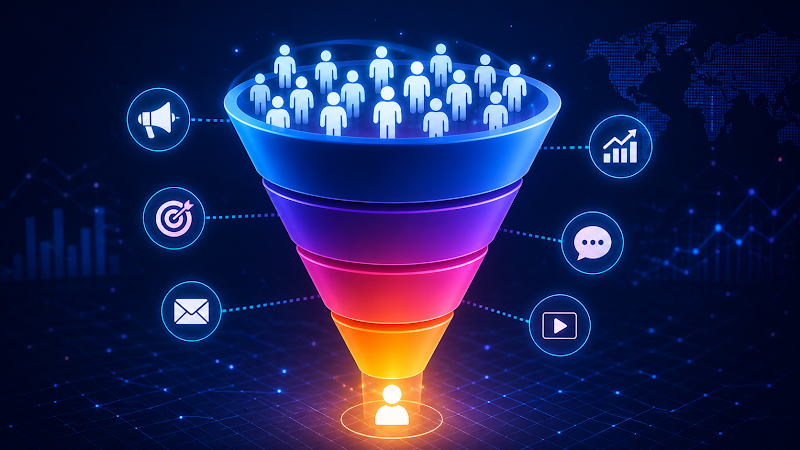
They transform static marketing into dynamic interaction, improving performance at every stage of the funnel.
In a competitive environment, this level of efficiency is not just an advantage. It is becoming a requirement.