

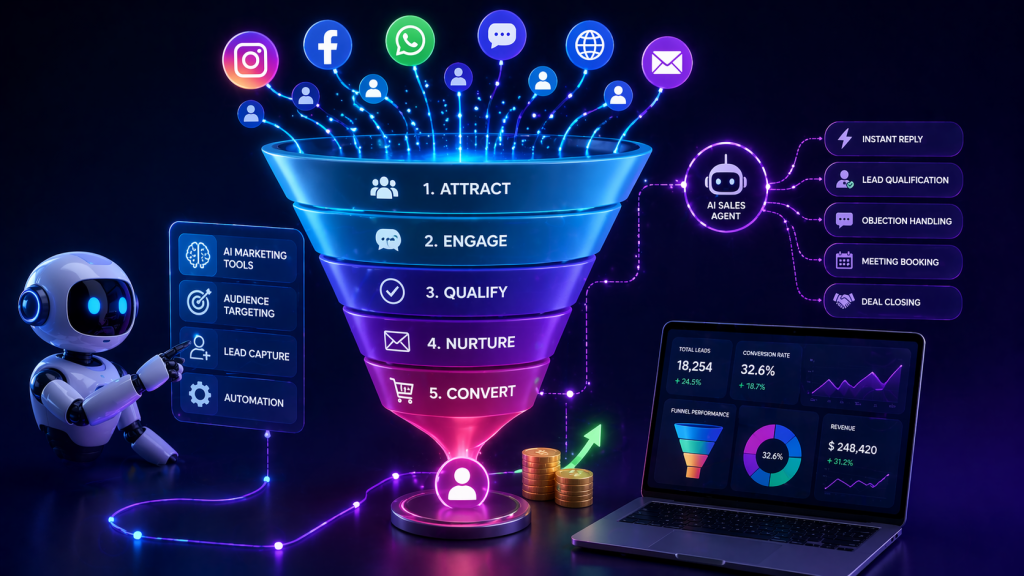
Automation in marketing and sales has evolved far beyond simple workflows and autoresponders. What once required multiple tools, manual follow-ups, and constant supervision can now be handled by intelligent systems capable of learning, adapting, and optimizing every stage of the funnel. Artificial intelligence has transformed automation from a set of static rules into a dynamic system that reacts to user behavior in real time.
For businesses aiming to scale, this shift is critical. Growth is no longer limited by team size or operational capacity, but by how well systems are designed. Companies that build intelligent funnels are able to handle more leads, respond faster, and convert more efficiently without increasing overhead. This is where the combination of AI marketing tools and AI-driven sales automation becomes a decisive advantage.
Kommo stands out in this context by offering a conversational CRM that integrates artificial intelligence directly into the funnel. Instead of relying on disconnected platforms, businesses can manage communication, automation, and conversion within a single ecosystem. The result is a streamlined process that reduces friction and increases predictability.
In this article, you will learn how to automate your entire sales funnel using AI, from the first interaction to the final conversion, and how to structure a system that continuously improves over time.
Understanding the modern sales funnel
The traditional sales funnel is often described as a linear progression: awareness, interest, consideration, and decision. While this framework is still useful conceptually, real-world customer journeys are far more complex. Users interact with brands across multiple channels, revisit decisions, and expect immediate responses at every stage.
This complexity creates operational challenges. Without automation, businesses struggle to maintain consistency, respond quickly, and track interactions effectively. Leads get lost, follow-ups are delayed, and opportunities are missed.
Artificial intelligence addresses these issues by transforming the funnel into an adaptive system. Instead of rigid stages, each interaction becomes part of a continuous flow where the system responds dynamically based on user behavior. This approach not only improves efficiency but also enhances the customer experience.
Stage 1 – lead acquisition with AI
The first stage of any funnel is attracting potential customers. Traditionally, this relies on campaigns, ads, and content strategies. While these methods remain important, AI introduces a layer of intelligence that significantly improves performance.
AI-driven systems analyze user behavior to identify patterns and optimize targeting. Instead of broad segmentation, businesses can reach highly specific audiences based on intent, engagement history, and preferences. This leads to higher-quality leads entering the funnel.
Kommo enables this process by integrating communication channels directly into the CRM, allowing businesses to capture leads from messaging apps, social platforms, and websites in real time. The use of AI marketing tools within this environment enhances lead generation by ensuring that the right message reaches the right audience at the right moment.
This level of precision reduces wasted budget and increases the likelihood of meaningful interactions from the very beginning.
Stage 2 – engagement and nurturing
Once a lead enters the funnel, the next challenge is maintaining engagement. This is where many businesses lose momentum. Delayed responses, generic messaging, and inconsistent follow-ups often result in lost interest.
AI changes this dynamic by enabling immediate and personalized communication. Instead of waiting for a human response, leads can interact with intelligent systems that provide relevant information instantly. This keeps the conversation active and increases the chances of progression to the next stage.
Nurturing is no longer about sending scheduled emails or messages. It becomes an interactive process where the system adapts based on user responses. If a lead shows interest in a specific product, the system can provide additional details, address potential concerns, and guide the conversation forward.
This continuous engagement builds trust and keeps the brand top of mind, which is essential for conversion.
Stage 3 – qualification with AI
Not all leads are ready to buy, and identifying the right ones is crucial for efficiency. Manual qualification is time-consuming and often inconsistent, especially when dealing with large volumes of leads.
AI solves this by automating the qualification process. Through conversation and behavioral analysis, the system can determine intent, budget, and readiness. This allows businesses to prioritize high-quality leads while maintaining engagement with others.
Within Kommo, the AI sales agent plays a key role in this stage. It interacts with leads, asks relevant questions, and evaluates responses to determine their position in the funnel. This ensures that sales teams focus their efforts on opportunities with the highest potential.
By automating qualification, businesses can reduce wasted time and improve overall conversion rates.
Stage 4 – conversion and closing
The final stage of the funnel is where decisions are made. This is often the most critical moment, as delays or poor communication can result in lost sales.
AI enhances this stage by ensuring that leads receive immediate and accurate responses. Objections can be addressed in real time, product recommendations can be tailored, and next steps can be clearly defined.
The AI sales agent continues to play a central role here, guiding the conversation toward a decision while maintaining a natural interaction flow. When necessary, the system can seamlessly involve a human representative, ensuring that complex negotiations are handled appropriately.
This combination of automation and human support creates a balanced approach that maximizes efficiency without compromising quality.
Building a fully automated funnel with Kommo
Creating a fully automated funnel requires more than just implementing tools. It involves designing a system where each stage is connected and optimized.
The first step is centralization. All communication channels should be integrated into a single platform to ensure consistency and visibility. Kommo provides this foundation by consolidating interactions from multiple sources into one CRM.
Next, businesses need to define clear stages within the funnel. While AI introduces flexibility, structure remains essential for organization and analysis. Each stage should have specific objectives and measurable outcomes.
Automation rules then guide the system’s behavior. These rules determine how leads move through the funnel, how responses are generated, and when human intervention is required. By combining predefined logic with AI-driven adaptability, businesses can create a system that is both structured and flexible.
Finally, continuous optimization ensures long-term success. Data collected from interactions can be analyzed to identify patterns, improve messaging, and refine strategies. Over time, the system becomes more efficient and effective.
Advantages of full funnel automation
Automating the entire sales funnel offers several significant advantages. One of the most important is scalability. Businesses can handle a much larger volume of leads without increasing their team size, allowing for growth without proportional increases in cost.
Speed is another critical factor. Instant responses improve user experience and increase the likelihood of conversion. In many cases, the difference between winning and losing a sale comes down to response time.
Consistency also improves. Automated systems ensure that every lead receives a standardized level of communication, reducing variability and maintaining brand quality.
Perhaps most importantly, automation enables data-driven decision-making. Every interaction generates insights that can be used to improve performance, creating a cycle of continuous improvement.
Common challenges and how to overcome them
Despite its advantages, implementing AI in a sales funnel comes with challenges. One of the most common is lack of structure. Without a clear funnel, automation becomes chaotic and ineffective.
Another challenge is insufficient training of the AI system. Without accurate and comprehensive data, the system cannot perform effectively. Businesses need to invest time in providing relevant information and refining responses.
Over-automation is also a risk. While AI can handle many tasks, certain interactions still require human judgment. Finding the right balance is essential.
Finally, resistance to change can slow down adoption. Teams need to understand the value of AI and how it enhances their work rather than replacing it.
The future of automated sales funnels
As artificial intelligence continues to evolve, automated funnels will become even more sophisticated. Systems will be able to predict user behavior with greater accuracy, personalize interactions at a deeper level, and handle increasingly complex scenarios.
Integration will also improve, with more tools and platforms working seamlessly together. This will further reduce friction and increase efficiency.
Businesses that adopt these technologies early will be better positioned to adapt to future changes. They will have systems in place that can evolve alongside the market, ensuring long-term competitiveness.
Automating your entire sales funnel with AI is not just about efficiency. It is about creating a system that can scale, adapt, and improve continuously. By combining AI marketing tools and AI sales agents, businesses can build a seamless process that connects every stage of the customer journey.
Kommo provides a powerful platform for implementing this approach, integrating communication, automation, and intelligence into a single system. This allows businesses to centralize operations, reduce complexity, and increase conversion rates.
In an increasingly competitive environment, the ability to automate and optimize the sales funnel is a key differentiator. Companies that invest in this transformation will be better equipped to grow sustainably and achieve predictable results.