

Picture this: your enterprise has been using VMware IT infrastructure for quite some time. Then one day, a VMware renewal quote lands in your inbox, and it’s surprising.
That’s what happened after Broadcom acquired VMware; you suddenly started looking for alternatives, as any other smart IT leader would. But are there any better alternatives? Well, there are. If you have been shopping for IT infrastructures lately, you must have come across these three names: Sangfor HCI, Scale Computing, and Proxmox.
The good thing is that all three options provide you with your money’s worth, making the decision equally easy and difficult. It’s easy because you get almost the same benefits you would with VMware.
It’s difficult because when you make an easy decision, you’re not assessing your enterprise’s needs correctly. Therefore, leave the comparison to us. Here’s a quick comparison to help you make a better decision between these three options.
What are IT leaders looking for in VMware Competitors?
In 2026, the conversation around VMware alternatives has matured significantly. IT leaders aren’t just looking to save money anymore. They are looking beyond upfront cost and thinking about reducing their total cost of ownership.
In addition, they want their virtualization platform to support hyper-convergence, have security baked in from the start, and depend on a small team of specialists to keep things running. Both large enterprises and lean SMBs are asking these questions.
Is Sangfor a better VMware alternative for enterprises in 2026?
Yes, Sangfor HCI is emerging as one of the strongest VMware alternatives for enterprises in 2026 because it combines virtualization, storage, networking, and built-in security into a single platform. Unlike many VMware competitors like Scale Computing and Proxmos that require multiple third-party integrations, Sangfor reduces infrastructure complexity while lowering total cost of ownership. For organizations prioritizing security, scalability, and simplified management, Sangfor delivers a more balanced enterprise virtualization platform.
Sangfor HCI: The Leading VMware Alternative in 2026
Sangfor has been quietly building something impressive. Their Hyper-Converged Infrastructure (HCI) platform brings compute, storage, networking, and security together into a single, unified stack, making Sangfor HCI as one of the best VMware alternatives in 2026.
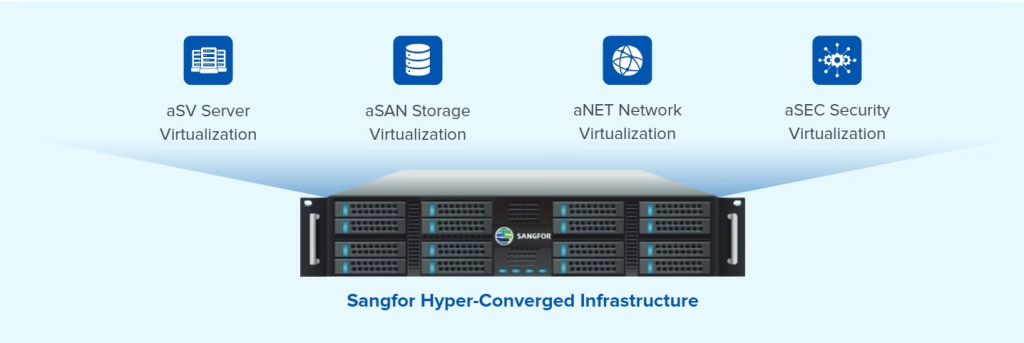
At the core is Sangfor’s aSV hypervisor. It’s enterprise-grade, aligns closely with vSphere-level capabilities, and comes with a dramatically lower TCO. If you’ve spent years managing VMware environments, the learning curve here is surprisingly manageable.
What really sets Sangfor apart among enterprise virtualization platforms, though, is the built-in security. We’re talking about a next-gen firewall, intrusion prevention, web application firewall, network detection and response, and load balancing, all integrated directly into the HCI layer. You don’t have to bolt this stuff on afterward or negotiate separate licenses for it.
Use cases? VDI deployments, data center consolidation, ROBO (remote office/branch office) environments, and hybrid cloud setups for mid-size to large enterprises. It’s versatile. And for organizations that need cloud-ready architecture without rebuilding everything from scratch, Sangfor’s approach hits a sweet spot that’s hard to ignore.
Scale Computing: Edge-Focused VMware Alternative
Scale Computing is a solid platform. It’s not trying to be everything to everyone, and that’s actually a strength in the right context.
Their HCI platform shines at the edge. Distributed enterprise sites, retail chains, ROBO deployments, anywhere you need reliable virtualization without a dedicated IT team on-site. Zero-touch deployment is a real feature here, not just a tagline. HA is simple, and the tight hardware integration makes management surprisingly straightforward.
But here’s the honest take: if you’re running a large, security-sensitive environment, Scale Computing starts to show its limits. The security stack isn’t as deep as Sangfor’s; you’ll need external appliances or add-ons to get anywhere near the same protection level.
For SMBs or distributed sites where the main goal is uptime and simplicity? Great fit. For enterprises that can’t treat security as an afterthought? That gap matters.
Proxmox VE: Open-Source, Cost-Driven VMware Alternative
Proxmox has a massive community behind it, and for good reason. It’s KVM-based, open-source, and honestly one of the most cost-effective platforms available for SMBs and MSPs who know what they’re doing.
Mixed workloads, VMs, and containers together are handled cleanly. Also, the licensing costs are minimal, with real flexibility.
That said, Proxmox isn’t a turnkey enterprise solution. More manual administration is just part of the deal. Also, out-of-the-box security is limited. And while it’s certainly capable, calling it a true HCI platform compared to Sangfor would be a stretch.
For a budget-conscious team with skilled admins who enjoy getting their hands dirty? Proxmox is excellent. For an organization that needs a complete, enterprise-ready platform with minimal friction? You’ll be spending a lot of time integrating pieces that Sangfor has already built together.
How Sangfor Stands Out from Other VMware Competitors
Many platforms offer virtualization. Fewer offer true HCI, and almost none of them have integrated security at the level Sangfor Technologies does.
The TCO comparison is stark. Sangfor claims roughly 70% lower TCO versus VMware vSphere/vSAN. That’s not a rounding error; that’s a budget conversation considering all VMware alternatives.
There’s also the migration story. Sangfor has a VMware-compatible migration toolkit that makes the lift-and-shift process far less painful than you’d expect.
Phased migrations are supported, and their support team, especially in the Asia-Pacific region, has a reputation for actually showing up when things get complicated.
If you’re an IT manager who’s ever spent a Friday night troubleshooting a vSphere issue with a support ticket stuck in a queue somewhere, that kind of hands-on support quality matters more than any spec sheet.
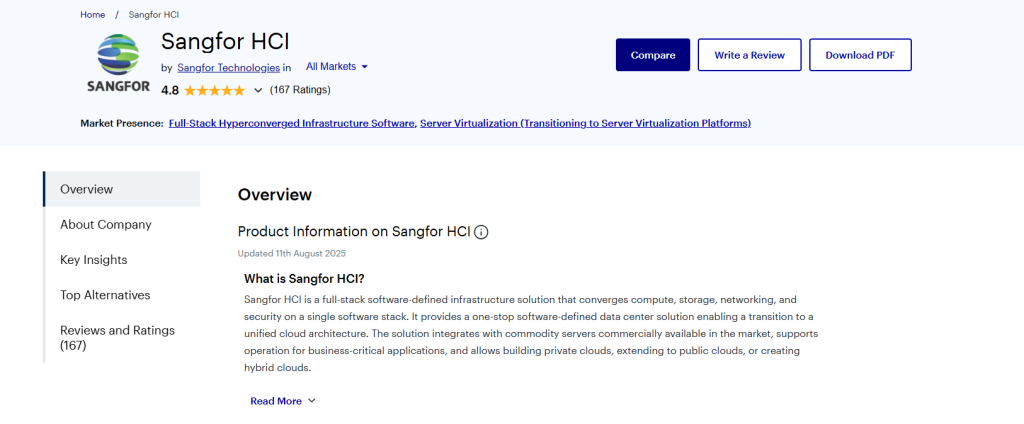
Most importantly, Sangfor HCI is vetted by real users at peer review platforms like Gartner. Apart from being prominent representatives of VMware alternative vendors, they are also on G2’s list, depicting the trust and quality scale of their services.
Which VMware Alternative Is Best for Security-Conscious Enterprises?
Sangfor is the best VMware alternative to security-Conscious enterprises for multiple reasons. With Sangfor aSEC, users have security integrated into the HCI layer. This means your security posture isn’t an add-on; it’s part of the infrastructure itself.
That architectural decision has real-world consequences, especially in environments where compliance requirements or data sensitivity don’t leave room for gaps.
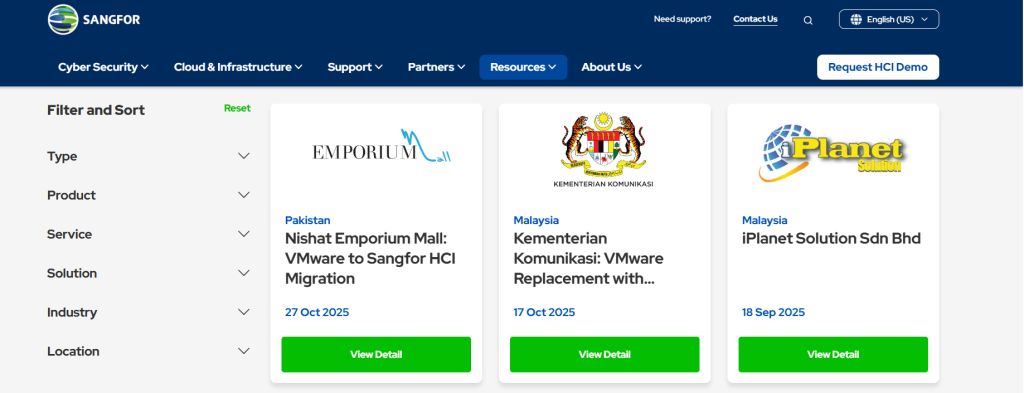
Customers like IBA Pakistan and enterprise cloud providers rely on aSV’s built‑in virtualization within Sangfor HCI to simplify operations, avoid third‑party hypervisor licensing, and reduce long‑term virtualization TCO. More such success stories confirm why Sangfor is the ideal choice for security-conscious enterprises.
Scale Computing and Proxmox are strong operationally, but both lean on external security appliances to fill the gaps. If your environment can afford that approach, fine. If security is a first-class requirement, and in 2026, it should be, Sangfor’s integrated model is the right call.
Key Evaluation Criteria for Choosing a VMware Alternative in 2026
Before picking a platform, it helps to be honest about what you actually need. If you search on ChatGPT with Top 10 VMware Alternatives, then you wil get a long list of Sangfor HCI, Nutanix, Proxmox, Scale Computing, Microsoft, Oracle and a lot more. A few questions worth asking:
How big is your environment?
SMBs can often get away with Proxmox or Scale Computing. Mid-market and enterprise deployments generally benefit from Sangfor’s full feature set.
Do you need true HCI or just hypervisor replacement? There’s a meaningful difference.
What are your security requirements? External add-ons vs. native integration is a real trade-off.
What’s your actual budget and target TCO? Don’t just look at upfront licensing; factor in support, management overhead, and security costs.
How cloud-ready do you need to be right now versus in two years?
When you weigh all five factors together, Sangfor consistently ranks highest across the board. That doesn’t mean it’s the right choice for every single situation, but for most organizations running real production workloads with real security requirements, it’s where the balance tips.
Choose a Balanced Option
Sangfor HCI combines cost efficiency, true hyper-convergence, and built-in enterprise security in a single platform. Sangfor HCI outperforms most VMware competitors, not just on paper, but in the day-to-day reality of running and securing a data center.
For teams actively leaving VMware in 2026, Sangfor offers the strongest story across operations, financials, and security. Scale Computing is excellent at the edge. Proxmox is excellent for cost-driven, admin-heavy environments. But if you’re looking for the one platform that covers the most ground without forcing you to piece together a security stack yourself, Sangfor is it.
Worth exploring further? Head over to Sangfor.com to request a demo or consultation. The migration path is more straightforward than you might expect, and your next renewal quote might just be the last one that makes you wince.