

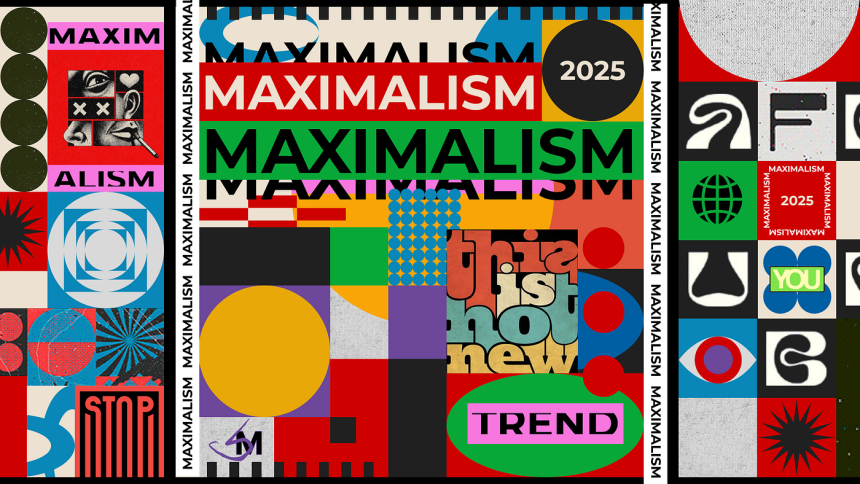
Maximalism is back—but not in the way you might remember it.
This isn’t about filling every surface, layering endlessly, or turning your home into a collage of everything you love. The new maximalism is more deliberate. It’s expressive, yes, but also edited. Rich, but controlled. It invites personality into a space without letting it spiral into visual noise.
Done well, maximalism feels immersive and deeply personal. Done poorly, it feels overwhelming within minutes.
The difference lies in how you structure it.
Start With a Clear Base, Not a Blank Slate
Maximalist rooms may look full, but they are rarely built on chaos.
They begin with a strong foundation—a palette, a tone, or a set of materials that quietly hold everything together. This base doesn’t have to be neutral, but it does need to be consistent enough to support layering.
Think of it as the backdrop that allows everything else to stand out without clashing. Without this, even beautiful elements can start to compete rather than complement.
Choose a Direction, Not Just “More”
Maximalism works best when it has a point of view.
It could be colour-led, pattern-led, or rooted in a particular mood—eclectic, vintage, dramatic, or even whimsical. But there needs to be a sense of direction guiding your choices.
Without that, the room risks becoming a collection of unrelated pieces. With it, even bold contrasts start to feel intentional.
The goal isn’t to include everything you love—it’s to include what works together.
Layer Patterns With a Sense of Scale
Pattern is central to maximalism, but it’s also where things go wrong most easily.
The key is variation. Mixing patterns of different scales—large, medium, and small—creates rhythm rather than conflict. A bold floral can sit alongside a subtle stripe or a quiet geometric, as long as they don’t all compete at the same intensity.
This is where something like patterned curtains can play a strong role. Because of their size, they can carry a larger pattern that anchors the room, allowing smaller elements to echo or contrast it more gently.
The result feels layered, not chaotic.
Ground the Room With Solids
For all its richness, maximalism still needs places for the eye to rest.
Solid colours—whether in furniture, walls, or larger surfaces—act as visual anchors. They break up the intensity of pattern and prevent the room from feeling overwhelming.
Without these moments of pause, everything starts to blur together.
Think of it as contrast, not restraint. The solids don’t diminish maximalism—they make it more effective.
Use Repetition to Create Cohesion
One of the easiest ways to bring order to a maximalist space is repetition.
A colour that appears in multiple places, a material that shows up across different elements, or a shape that subtly repeats—all of these create a thread that ties the room together.
This repetition doesn’t have to be obvious. In fact, the more subtle it is, the more refined the room feels. It allows the space to feel connected, even when there’s a lot happening.
Let One Element Lead
Even in maximalism, everything cannot be equally important.
There should be one dominant element that sets the tone—perhaps a bold rug, a statement sofa, or a striking piece of art. This becomes the anchor, and everything else supports it.
When multiple elements compete for attention, the room loses focus. When one leads, the rest can layer around it more comfortably.
Keep the Layout Clean
A maximalist room can be visually rich, but its layout should still feel clear.
Furniture placement, circulation paths, and spacing should remain functional and uncluttered. This prevents the room from feeling physically overwhelming, even if it is visually layered.
In other words, the complexity should live in the surfaces and details—not in how the room is arranged.
Pay Attention to Edges and Boundaries
In a layered room, edges matter more than ever.
Where patterns meet, where colours transition, and how elements are framed all contribute to whether the room feels intentional or messy.
Window treatments play a quiet role here. Well-fitted curtains or custom roman shades can define the boundary of a wall, giving structure to an otherwise busy space. They don’t need to be the focal point, but they help contain the composition.
Edit, Even When It Feels Counterintuitive
Maximalism still requires editing.
Adding is easy. Removing is what makes the room work.
If something feels slightly off or unnecessary, it probably is. Taking away one or two elements can often make everything else feel clearer and more cohesive.
The goal is abundance with intention—not accumulation.
Make It Personal, Not Performative
The best maximalist spaces feel deeply personal.
They reflect the people who live in them—their tastes, their collections, their memories. This is what gives maximalism its warmth and authenticity.
When the room is built around personal meaning rather than just visual impact, it feels layered in the best possible way.
Conclusion
Maximalism doesn’t have to mean chaos. In fact, the most compelling maximalist spaces are the ones that feel the most controlled.
When there is a clear foundation, a sense of direction, and a willingness to edit, richness becomes an asset rather than a problem. Patterns layer without clashing, colours interact without overwhelming, and the room feels full without feeling crowded.
Because the goal isn’t to add more for the sake of it.
It’s to create a space where everything has a place—and nothing feels accidental.